Signs the pipe is the problem, not just a clog
A clog is something stuck in a sound pipe. Once it’s cleared, it stays cleared. A damaged pipe keeps catching waste, so the trouble comes back.
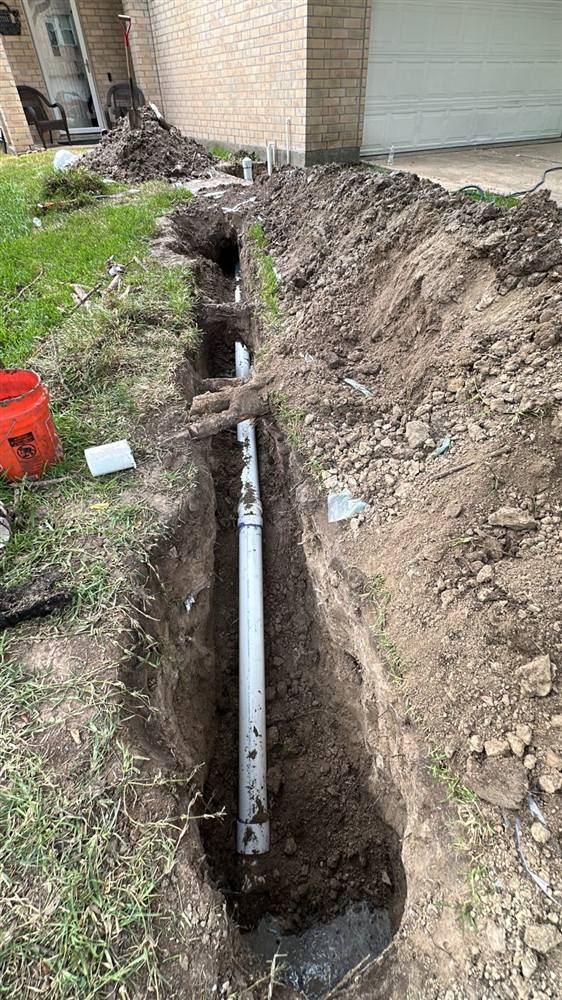
The backup returns within weeks of a cleaning. A crack, a sag or a root-filled joint is holding on to paper and waste.
Roots show up every time the line is opened. Roots only get into a sewer pipe through a crack or an open joint. Cutting them buys time, but the opening is still there.
A sewage smell outside, or a soft, wet patch of yard along the path of the line when it hasn’t rained.
Drain trouble after foundation work. When a house moves, the pipes under it move too, and a joint can pull apart.
Cast iron under older Houston homes
Plastic drain pipe (PVC and ABS) wasn’t allowed in homes under most plumbing codes until the early 1970s, according to Contractor magazine, so many Houston houses built before the mid-1970s have cast iron drains under the slab. About 40% of the city’s homes were built between 1940 and 1979, according to the U.S. Census Bureau.
Old cast iron wears from both sides. Inside, rust and scale roughen the walls, so paper and grease catch and the pipe narrows. Outside, the soil works on it: the Cast Iron Soil Pipe Institute says a soil’s resistivity, pH, moisture, sulfides and oxidation-reduction potential decide how corrosive it is. That’s why two houses on the same street can have pipes in very different shape. Nobody can tell you how many years your cast iron has left without looking inside it, and not every old line needs replacing.
Clay soil that swells and shrinks
Much of Houston sits on the Beaumont Formation, whose clay soils the Houston Geological Society calls highly expansive. In wet months the clay swells; in a drought it shrinks and cracks. Over the years, that push and pull can shift a buried pipe enough to open a joint, crack it, or let a section sink into a low spot, called a belly. The plumbing code sets a minimum slope for sewer pipe so waste keeps moving. A belly breaks that slope, and solids settle there.
What a camera inspection shows
A sewer camera on a long push cable goes in through a cleanout and shows the inside of the pipe on a screen: roots at a joint, an offset where one pipe has shifted off the next, a belly holding water, cracks, flattened or crumbling cast iron, and heavy scale. Many cameras carry a locator, so the plumber can mark on the ground where the problem is and about how deep.
A repair quote without a camera look is a guess about where the pipe failed and how much of it is bad. Before you approve a sewer repair from any company, ask to see the footage or pictures of the problem spots.
Where your line ends and the City’s begins
Inside Houston city limits, Houston Public Works says private wastewater pipes, typically the ones closer to the home, are the homeowner’s responsibility, and pipes on a public right-of-way are the City’s. The City uses cleanouts to mark the limits of its public system. So a broken pipe between your house and that cleanout is usually yours to repair. Outside city limits, your city or MUD draws that line, so ask them which applies to your address.
Insurance and home warranties
The Texas Department of Insurance says most home policies don’t cover wear and tear, and an old pipe that slowly rusted through may fall under that. Sewer or drain backup, and damage to foundations or slabs, are optional add-ons (endorsements), so check your policy for both. Home warranty companies are licensed by TDLR, and coverage depends on your contract.
Sources: Houston Public Works, Protect Our Pipes · U.S. Census Bureau, ACS 2024, year built (Houston) · Contractor magazine, plumbing the past 70 years · Cast Iron Soil Pipe Institute, soils test · Houston Geological Society, Beaumont clay · Texas Department of Insurance, home insurance guide · TDLR, home warranties