The three reasons the EPA says to clean ducts
The EPA has no blanket rule that ducts should be cleaned. It says to clean them only as needed, for three reasons: substantial visible mold growth inside hard-surface (sheet metal) ducts, rodents or insects in the ducts, or ducts so clogged that dust is actually blowing out of the registers. Beyond that, in the EPA’s words, duct cleaning “has never been shown to actually prevent health problems.”
That’s our bar: find one of the three and we show you; find none and we say so and look for the real cause.
What we check in your attic first
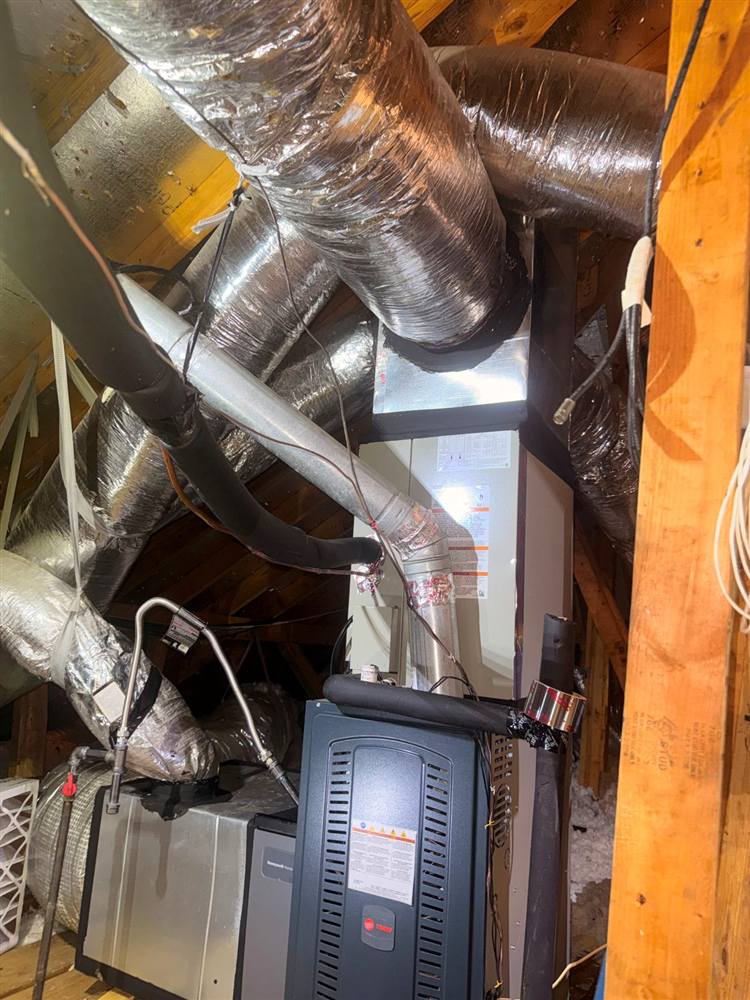
The free diagnostic covers the whole system: the filter and return grille, since an undersized return or a filter gone gray makes every room dusty; the indoor coil and drain pan, which the EPA counts as parts a cleaning should include; the runs, for flex crushed under a stored box, sagging, off its boot or lying in wet insulation; and the plenums and collars, where attic air leaks in and cooled air leaks out. You get one of four answers: leave it, clean, seal, or replace a run.
What a proper duct cleaning looks like
The EPA gives homeowners a checklist for judging a cleaning, and we’d rather you hold us to it. Furnishings get covered. A vacuum that exhausts inside the house needs HEPA filtration, because a weak collection system “can release more dust, dirt and other contaminants” than leaving the ducts alone.
Every part that carries air gets cleaned, since skipping one “can result in re-contamination of the entire system.” Access holes are sealed and re-insulated airtight. Afterward, you shouldn’t be able to see any debris with the naked eye, and the drain pan should be clean and draining. NADCA’s ACR Standard is the written method the EPA tells homeowners to ask about; ask us what equipment we’ll bring and which parts are in the quote.
Leaky ducts in a Houston attic
ENERGY STAR estimates that “about 20 to 30 percent of the air that moves through the duct system is lost due to leaks, holes, and poorly connected ducts,” and names attic ducts as a warning sign. That’s the Houston setup: a vented attic in July runs hotter than the air outside, and every gap at a collar or boot trades cooled air for attic air. Sealing closes those gaps at the joints, collars, boots and plenum with “mastic sealant or metal tape,” never duct tape.
For contractors, ENERGY STAR adds aerosol-based sealant as an option, R-6 or higher insulation on attic ducts, and a combustion safety test after sealing where there’s a gas furnace. Your written price says which method fits your ducts.
Sweating ducts and wet insulation
A duct carries cold air through hot, humid attic air. Wherever its surface is colder than the dew point of the air around it, water condenses, the way a glass of iced tea sweats on the porch. The EPA is plain about the result: if duct insulation “gets wet or moldy it cannot be effectively cleaned and should be removed and replaced.”
A soaked run is a replacement, not a cleaning. ENERGY STAR’s certified-new-home program requires R-8 duct insulation in attics, and the Department of Energy notes that high-R insulation with a vapor barrier is what keeps condensation off the duct.
When a run should be repaired or replaced instead
Some ducts are past sealing: flex that’s crushed, torn, brittle or sagging in loops; a boot that fell off and has been blowing into the attic all season; a plenum rusted or splitting at the seams; a return too small for the blower, which ENERGY STAR notes is common. Your technician will tell you which of those can be repaired and which need a new run, and ENERGY STAR says the job should end with an airflow check.
Census figures show about 40% of Houston homes were built between 1940 and 1979, and a house that age may be on its third air conditioner with the original attic ducts.
How to spot a duct-cleaning rip-off in Houston
Duct cleaning draws more than its share of bait-and-switch offers, and the warning signs are easy to learn; most come straight from the EPA’s own page. A whole-house price in the ad that’s a small fraction of what the work takes, and grows once the crew is in your attic. “Mold” found on the spot with no photo and no test; the EPA says ask to be shown it, then get laboratory confirmation.
Claims of EPA certification, when the EPA certifies, endorses and approves no duct-cleaning company. And no license number in the ad: Texas requires every ad offering air conditioning work to carry the contractor’s license number (16 TAC §75.71). Ours is TACLB84395E.
Sources: U.S. EPA, should you have your air ducts cleaned · U.S. EPA, mold and moisture guide · ENERGY STAR, duct sealing · ENERGY STAR, professional duct contractor · U.S. DOE, high-R duct insulation · NWS Houston, July normals (IAH) · U.S. Census Bureau, ACS, Houston · 16 TAC §75.71 · NADCA ACR Standard. Checked November 2026.