How a heat pump heats and cools
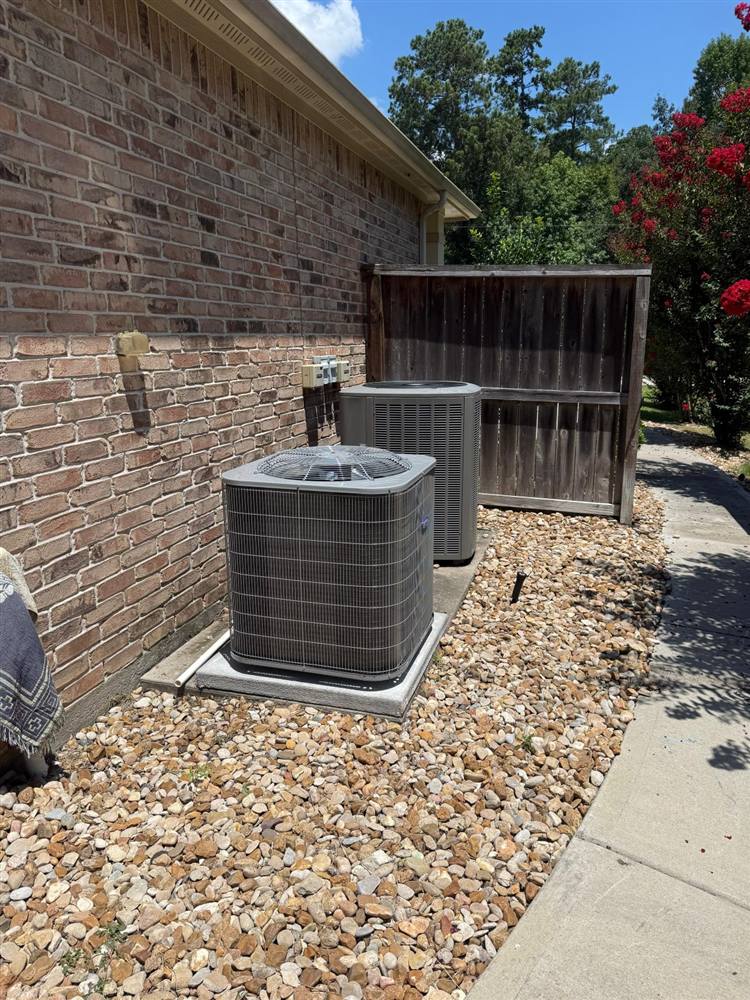
From the yard, a heat pump looks just like a central AC unit. The difference is the reversing valve inside the outdoor unit, which lets the system run in either direction. In summer, it pulls heat out of your house and releases it outside, like an AC. In winter, the valve flips the flow, and the system pulls heat from the outdoor air (there is still usable heat in 40-degree air) and moves it indoors.
Indoors, a heat pump is paired with an air handler instead of a gas furnace. The air handler holds the indoor coil, the blower and, in most homes, electric heat strips for backup. Because a heat pump moves heat rather than making it, it normally heats with less electricity than the strips alone, which is why the strips matter so much to your bill.
Why heat pumps make sense in Houston
Our climate is mostly a cooling problem. The National Weather Service puts Houston’s average first freeze on December 9 and the average last freeze around February 15. NOAA’s 1991–2020 normals for Bush Intercontinental Airport show only about 10 nights a year at or below freezing. Mild winter weather is where a heat pump does its best work.
The catch is the hard freeze. During Winter Storm Uri, Bush Intercontinental dropped to 13°F on February 16, 2021. On nights like that, the backup strips carry much of the load, and a heat pump with a weak part usually shows it.
Defrost mode: why the outdoor unit steams
When it’s cold and damp, frost builds up on the outdoor coil while the heat pump heats. Every so often the system clears it with a defrost cycle: it switches to cooling for a short time to warm the outdoor coil, the outdoor fan usually stops, and you may hear a whoosh as the reversing valve shifts. Then steam rises off the unit. That’s melting frost, not smoke.
A defrost usually lasts a few minutes and ends on its own, and the backup heat often comes on so the vents don’t blow cold air. A short hiss when the system shuts off is also normal. Grinding, rattling or a fan blade striking ice is not: turn the system off and call.
AUX heat, emergency heat and your electric bill
AUX on your thermostat means the electric heat strips are helping. They come on when it’s too cold for the heat pump alone, during defrost, and when you raise the setting several degrees at once. Strips turn electricity straight into heat, so they cost more to run than the heat pump. A few hours of AUX on a freezing night is expected. AUX on a mild day, or a winter bill that jumps when it wasn’t especially cold, usually means low refrigerant, a failed outdoor part, a defrost that won’t finish or a thermostat calling for the strips too early. EM (emergency) heat shuts the heat pump off and runs only the strips: save it for when the outdoor unit has failed or is iced solid.
Not heating, or blowing cool air
If the outdoor unit is silent while the indoor fan runs in heat mode, the house is getting only strip heat, which is slow and expensive. Common causes are a failed capacitor or contactor, an outdoor fan motor, low refrigerant or, on older units, the compressor. Heat pump air feels warm, not hot, but cool air from the vents for more than a few minutes outside of a defrost is worth a call.
Outdoor unit iced over and not clearing
A thin white frost that comes and goes is normal. Thick ice over the whole coil, the top or the fan that stays for hours is not. Usual causes are a failed defrost control board or sensor, low refrigerant, a dirty coil, an outdoor fan that isn’t turning, or a gutter dripping onto the unit. Don’t chip at the ice or pour hot water on the coil: the thin fins bend and puncture easily. Switch the thermostat to EM heat so the outdoor unit stops, and call us.
Stuck in one mode: the reversing valve
If the system cools when it should heat, heats when it should cool, or blows lukewarm air in both modes, the problem is usually in the reversing valve circuit. Sometimes it’s the thermostat setup or wiring, or the small electric coil (solenoid) that moves the valve: smaller repairs. Sometimes the valve itself is stuck or leaking inside. Replacing it means recovering the refrigerant, brazing in a new valve and recharging, so on an older unit it’s often where we price repair and replacement side by side.
Repair or replace: signs on a heat pump
Most heat pump problems are repairs. These signs point toward replacing:
• The compressor or the reversing valve has failed on a unit that’s well along in years
• It still uses R-22, a refrigerant phased out of U.S. production in 2020
• It loses refrigerant season after season
• Defrost or AUX problems keep coming back after repairs
• ENERGY STAR suggests considering a replacement once a heat pump is “more than 10 years old”
We’ll give you both prices so you can compare. If another company already quoted you a new heat pump, we’ll give you a free second opinion.
Replacing a heat pump in 2026: what changed (checked November 2026)
Efficiency minimums. Under Department of Energy rules, a new split-system heat pump must rate at least 14.3 SEER2 for cooling and 7.5 HSPF2 for heating (HSPF2 measures heating efficiency over a season; higher is better). Single-package heat pumps, with everything in one outdoor cabinet, have a lower minimum of 13.4 SEER2 and 6.7 HSPF2.
Refrigerant. Heat pumps built since January 1, 2025 use lower-impact refrigerants, mostly R-454B or R-32. Under an EPA rule in effect since July 27, 2026, R-410A equipment made before 2025 can still be installed while supplies last. A new outdoor unit needs an indoor coil built for the same refrigerant, and an R-410A heat pump you already have can still be repaired.
No federal tax credit. The Section 25C credit doesn’t cover a heat pump placed in service after December 31, 2025, under Public Law 119-21. A 2026 install doesn’t qualify, whatever older ads may say.
Warranty. Terms depend on the brand and model, and some require registration. Your estimate lists the exact warranty.
Sources: National Weather Service Houston/Galveston, heat and cold stats · NOAA, Local Climatological Data for Houston Bush Intercontinental (IAH), 1991–2020 normals · NOAA/NWS daily records for Bush Intercontinental (IAH) · 10 CFR 430.32, DOE efficiency standards · U.S. EPA, refrigerant rules by sector · U.S. EPA, HFC phasedown questions · IRS, Energy Efficient Home Improvement Credit · CenterPoint Energy, heating and cooling incentives · Texas SECO, home energy rebates · ENERGY STAR, when to replace · U.S. DOE, Energy Saver guide. Checked November 2026.